
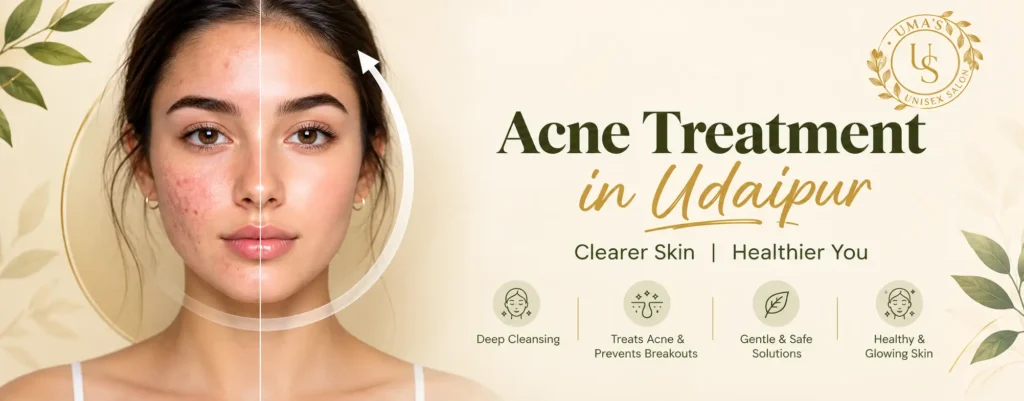
If you have been fighting pimples for months, or years, you already know how draining it is. You try a new face wash, a neighbour’s home remedy, a cream a friend swears by, and the breakouts still come back. Often they leave dark marks behind as well.
This guide is for anyone in Udaipur who wants a clear, honest picture of acne treatment in Udaipur: why acne happens, which treatments are available, which ones suit which skin type, and when it is better to see a doctor than a salon. It is written for teenagers, college students, working professionals, and brides-to-be who want their skin sorted before an important date.
The short answer: Acne is not fixed by one miracle product. Mild to moderate breakouts usually respond well to a steady routine plus professional skin care like deep-cleansing facials, medifacials and gentle peels. Painful, deep, or scarring acne needs a dermatologist. The right plan depends on your acne type, your skin type, and how long you have had it.
Causes of Acne and Pimples
Acne starts inside the pore. Each pore holds a hair follicle and an oil gland. When the gland makes too much oil (sebum), and dead skin cells don’t shed properly, the two mix and block the pore. Bacteria that normally live on the skin then multiply inside that blocked space, and your body responds with redness and swelling. That is a pimple.
Several things push this process along:
- Hormonal changes. Puberty, periods, pregnancy, and conditions like PCOS can all increase oil production.
- Genetics. If your parents had stubborn acne, you are more likely to have it too.
- Heat, sweat and dust. Udaipur’s long hot season means more sweating and more grime sitting on the skin, especially if you ride a two-wheeler daily.
- Heavy or pore-clogging products. Thick creams, oily hair products touching the forehead, and some makeup can block pores.
- Stress and poor sleep. These don’t create acne from nothing, but they often make existing acne worse.
- Picking and squeezing. This pushes bacteria deeper and is one of the biggest reasons pimples turn into marks and scars.
Food is a debated topic. Some people notice flare-ups with very sugary or dairy-heavy diets, but research is mixed, so there is no single “acne diet” that works for everyone. A simple way to find out is to observe your own skin over a few weeks instead of cutting out everything at once.
Types of Acne: Know What You Are Treating
Not every pimple is the same, and the treatment changes with the type.
| Type | What it looks like | Usually needs |
|---|---|---|
| Blackheads and whiteheads | Small dark or flesh-coloured bumps | Cleansing, exfoliation, extractions |
| Papules and pustules | Red, tender bumps; some with a white tip | Medicated care, gentle peels, consistent routine |
| Nodules and cysts | Large, deep, painful lumps under the skin | A dermatologist, not a salon |
| Hormonal acne | Jawline, chin and lower-cheek breakouts, often before periods | Medical evaluation plus supportive skin care |
If most of your acne sits in the first two rows, a good skin care routine and professional facials can make a real difference. If you recognise the last two, jump ahead to the section on seeing a doctor.
Acne Treatment for Oily Skin
Oily skin is the most common skin type among people who struggle with breakouts, and it needs a balanced approach. Over-washing and harsh scrubbing is the mistake we see most often. Stripping the skin makes it produce even more oil to compensate.
A sensible routine for oily, acne-prone skin looks like this:
- Cleanse twice a day with a gentle, sulphate-free face wash. A salicylic acid cleanser works well for many people because it can get into the pore.
- Moisturise, even if your skin feels greasy. Choose a light, gel-based or “non-comedogenic” formula. Dehydrated skin often breaks out more.
- Use sunscreen every morning. Pick a lightweight, oil-free SPF 30 or higher. In Rajasthan’s sun, this is also the best protection against acne marks turning darker.
- Add one active at a time. Ingredients such as benzoyl peroxide, adapalene, niacinamide or azelaic acid are commonly used for acne. Introduce just one, use it a few nights a week, and give it six to eight weeks before judging it.
- Never sleep in makeup, and wash anything that touches your face: pillowcases, towels, phone screens.
At the salon, a deep-cleansing or acne-control facial for oily skin typically focuses on removing congestion safely, calming inflammation, and balancing oil without drying the skin out. It works best when repeated at regular intervals and supported by a home routine.
Why Choose Unisex Uma Salon for Acne Care in Udaipur
If you are looking for the best salon in Udaipur for acne care, start with how a salon treats you before it treats your skin. At Unisex Uma Salon in Udaipur, skin care begins with a conversation. Before any facial or peel, your skin type, current products and concerns are discussed so the treatment is matched to you, not copied from a menu. Both men and women are welcome, and the focus stays on gentle, realistic care that fits your skin and your schedule.
If you are preparing for a wedding, an engagement or any big event, come in at least two to three months ahead. That gives acne and marks enough time to improve properly, instead of rushing in the last week.
Hormonal Acne Treatment in Udaipur
Hormonal acne has a recognisable pattern: deep, tender pimples around the chin and jawline that flare before your period, or breakouts that begin or worsen in adulthood. If you also have irregular periods, excess facial or body hair, or sudden weight changes, it may be linked to a hormonal condition such as PCOS.
Here is the honest truth: hormonal acne usually cannot be cleared by facials or creams alone. The cause is internal, so a doctor needs to look at the whole picture. A gynaecologist, endocrinologist or dermatologist may suggest blood tests and may prescribe medication.
What a skin care professional can do is support the treatment. That means keeping pores clear, calming inflammation, and protecting your skin barrier while the medical treatment takes effect. Patience matters here, because hormonal acne often needs two to three months of steady care before the improvement becomes obvious.
Acne Treatment Options and Procedures
There is a wide range of options, from simple home care to medical procedures. Here is how they fit together.
At-home care
Gentle cleansing, a suitable moisturiser, daily sunscreen and one well-chosen active ingredient. This is the base for everything else. Even the best professional treatment will not hold without it.
Professional salon treatments
For mild to moderate acne, these are commonly used:
- Deep-cleansing and acne-control facials that remove blackheads and clear congested pores
- Medifacials that combine cleansing, exfoliation and soothing steps for problem skin
- Superficial chemical peels using acids like salicylic or mandelic acid to loosen clogged pores and improve texture
- Hydration and barrier-repair care that keeps skin calm between treatments
Dermatologist-led treatments
For moderate to severe acne, a dermatologist can offer prescription creams, oral antibiotics, hormonal therapy, or other medicines, and can decide whether stronger in-clinic procedures are suitable. These are prescription decisions, and they should come from a qualified doctor after examining your skin.
How long does it take?
Skin renews itself roughly every four to six weeks, so most treatments need at least six to eight weeks to show a clear result. Anyone promising a pimple-free face in three days is overselling.